
Hello Readers of the Milwaukee Film blog,
For any of you who may not have noticed yet, we have made some changes with our blog, so it is now hosted directly on our website. To continue receiving updates from our blog, please update your bookmarks with the new url: http://www.milwaukee-film.org/blog/
Thank you and we hope to hear from you if you have any comments, questions or suggestions for our blog.
Milwaukee Film
http://www.milwaukee-film.org/blog/
Monday, March 8, 2010


Tuesday, February 23, 2010
Because Reality TV is Lame.

// By Anna Krutzik //
Today is Tuesday, also known as New DVD Day!
There are several notable films this week, a couple of which I feel contractually obligated to mention, as both screened at the 2009 Milwaukee Film festival: $9.99 and Shall We Kiss. $9.99 is an exquisite stop-motion animation by Israeli animator Tatia Rosenthal about one man's quest for the meaning of life. Shall We Kiss is a french romantic comedy about two friends who would like to kiss each other. You should rent these two films...so ends my shameless film festival plug.
The film that I'm most interested in promoting is the DVD release of Sorority Row. Directed by relative newcomer Stewart Hendler, this remake of 1983's House on Sorority Row delivers a surprisingly good rendition of pop culture via cheesy horror film stereotypes and a good dose of bitchy girl power thrown in.
The cast includes the who's who of today's IT girls (Briana Evigan, Margo Harshman, Rumer Willis, Jamie Chung, Leah Pipes) whose names you might not recognize, but that doesn't matter because none of them were chosen for their great acting skills and some are already on their way out of America's collective consciousness (The Hill's Audrina Patridge). The dialogue is uncharacteristically smart (sometimes) and even funny (in a good way).
The film doesn't pretend to be anything but a bunch of popular girls wearing cool (a.k.a slutty) clothes that run around and get slaughtered. But it does what it does well. Once the killer comes around there isn't an endless 15 minute chase scene, people start dying and they do so in a big way. But the best part of Sorority Row has to be Carrie Fisher who plays the shotgun-wielding house mother of the girl's sorority.
Pop culture on celluloid, sparkly and fun.
*Still image from Sorority Row
Friday, February 19, 2010
See You at the Movies!

// By Anna Krutzik //
So, it is a nondescript Friday in February and once again you're looking to go out and enjoy a movie in your local cinema because frankly there isn't much else to do in February in Wisconsin (*which I know is a false statement. There is a lot to do in Milwaukee on the weekends, but this is a film blog so we pretend that all that other stuff doesn't exist. It's a little biased but it makes for a more consice blog).
There is always the UWM Union Theatre which is showing Beeswax (directed by Andrew Bujalski) and Loren Cass (directed by Chris Fuller) this weekend, both of which are Milwaukee premieres. So you could go to that. The Union Theatre is always fun and cheap and rarely overcrowded (I mean it merely as an observation and a potential selling point, because some people don't like crowded movie theaters).
Or you could go see Shutter Island, Martin Scorsese's newest film set in 1954 about a U.S. Marshall investigating the mysterious dissapearance of a patient from the creepy mental institution on Shutter Island. Ooooh, sounds scary and mysterious and thrilling! The film is adapted from Dennis Lehane's book of the same name (Lehane is also the writer of Gone Baby Gone and Mystic River). And I must say, Shutter Island is the first film to be released in theaters in a long, long, long time that I am actually excited about seeing. And I have a couple of reasons for that. Let me share them with you:
1) It's Martin Scorsese. I think everyone can agree that the man makes damn good films. Classy and beautiful and very entertaining films. And on a personal side note, I once saw him give a moderated commentary on his life and career during the Ivy Film Festival at Brown University and it was wonderful and I now can't help but feel that we are best friends.
2) Leonardo DiCaprio. Leo, if you will. Yes, I was 12 years old when Titanic hit theaters and callously plucked the heart strings and hard-earned allowance money of countless little girls. The damage is done. Although, in all seriousness, he is a mighty fine actor. Mighty fine. Ahem.
3) Mark Ruffalo, Michelle Williams, Ben Kingsley, Emily Mortimer, Max Von Sydow, Patricia Clarkson, Ted Levine, and Jackie Earle Haley round out the cast. All talented actors. All in this movie.
These are more than enough reasons to get excited about this film.
Okay, so maybe some critics aren't giving this film the best of reviews but they aren't giving it bad reviews necesarily. And I think it is safe to say that I can sit through anything made by Scorsese because nothing he makes can be that bad. Shutter Island looks like an intriguing thriller that takes its audience along for a ride in the same vein as many Alfred Hitchcock films. And I think everyone can use a little Hitchcock now and again, especially when it's packaged as a Scorsese.
Wednesday, February 17, 2010
The Silver Lining on the Silver Screen
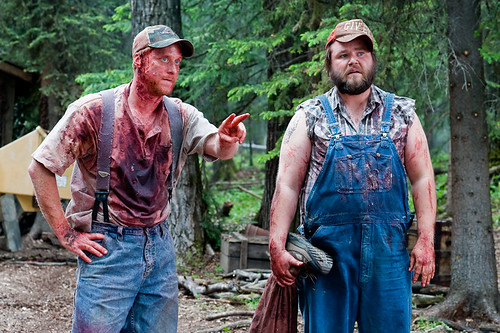
// By T.J. Fackelman //
Lest you all begin to think it´s nothing but "doom and gloom" at the 60th Anniversary of the Berlinale, I´d like to tell you about a few of the less bleak titles I´ve enjoyed so far. The one that has elicited the most laughs from myself and fellow audience members by far has been TUCKER & DALE VS. EVIL. This hilarious (yet slightly gory) comedy follows a group of college frat boys and their female friends on a camping trip into the Appalachian woods. At the same time, Tucker and Dale, two good ole´boys who like nothing more than downing a few beers and fishing, are on their way to Dale´s recently purchased "summer house," a rundown cabin deep in the forest. What begins as the perfect vacation for both groups turns into a grisly nightmare as limbs get hacked off and bodies begin to pile up. Is it the "pure evil lurking in the forest" that the local sheriff warned them about, or is it something worse? Could there be a suicide cult??
One thing is for sure...this ain´t DELIVERANCE!
Another wild ride is also one of the most hyped films of both the Berlinale and the recent Sundance Film Festival, Banksy´s EXIT THROUGH THE GIFT SHOP, which according to the press materials, directed itself. The mysterious Banksy may be the main draw of the film, but it´s the eccentric and fanatical filmmaker Thierry Guetta who gets the most screen time and steals the show. But Banksy full on admits this right off the bat in the opening interview segment which distorts both his voice and face, concealing his true identity. Guetta´s cousin is a street artist named Space Invader who specializes in creating and displaying mosaics in the likeness of baddies from the classic arcade game of the same name. It´s through this relationship that Guetta first meets fellow street artist Shepard Fairey, best known for his blue and red image of Barack Obama used in the 2008 Presidential Election Campaign, as well as many other artists using urban walls, sidewalks and streets instead of canvasses. Guetta´s excitement over filming these street artists is overly infectious, and his excitement becomes a full on obsession when he begins his mission to find the elusive Banksy. The artists agree to let Guetta film them because he claims he´s making the definitive street art documentary, but he confesses that he has no such intention. He just wants to film them.
In the dead of night, we witness Guetta and his subjects scaling walls, and climbing onto rooftops to create their art without being seen. And this stuff truly is art, not just ugly graffiti or simple tags, proven by the hundreds of thousands of dollars some collectors have paid to own a Banksy.
In the end, it´s up to the viewer to try to decide who´s putting on who and what´s real and what isn´t in this post-modern meta-documentary (the film that "directed itself"). No matter what you decide, it´s impossible to not have a blast watching this film that´s unlike anything you´ve ever seen before.
Tuesday, February 16, 2010
Exquisite Gloom and Doom

// By Jonathan Jackson //
Film festivals sometimes cast a dark shadow over their audience. It is a full-on eclipse at the 60th Berlinale.
My two fiction favorites thus far are no exception. Sundance Jury Prize winner WINTER'S BONE from Debra Granik and Thomas Vinterberg's return to form, the Danish SUBMARINO, both center on a subject many of us, maybe all if we are honest, can relate to: being the child of a dysfunctional parent(s).
Fulfilling the promise of her 2004 debut DOWN TO THE BONE, Debra Granik's WINTER'S BONE is a riveting, slow burn thriller that follows an Ozark mountain teenage girl, Ree (Jennifer Lawrence in a breakout role). Ree is desperately searching for her out-on-bail father so that her family does not lose their home and land, which he put up for bail. When not taking care of her catatonic mother, or two younger siblings, Ree must stand-up to an entire, seemingly lawless community whose only common value is to remain silent.
WINTER'S BONE could easily have become a cliche-riddled melodrama, in Granik's hands it becomes first rate thriller with the best depiction of a lost American mountain community this side of DELIVERANCE.
While Granik fulfilled the promise of her debut film immediately, Vinterberg has not. His three films following his hugely influential, masterful Dogme 95 debut film THE CELEBRATION all flopped with audiences and critics.
SUBMARINO will change that, at least with critics.
Me leading contender for the Berlinale Golden Bear, SUBMARINO is an unsparring, unflinchingly realistic look at two estranged brothers who are struggling to overcome an abusive and alcoholic mother, an absent father, drug addictions, poverty and the death of their little brother as an infant. Basically your typical date night movie!
Apaprently, SUBMARINO is the term for a type of water torture where the victim's head is held underwater until just before the moment of drowning. Vinterberg does the same to his two leads.
Soul bearing, pitch-perfect performances from the brothers, Danish actors Jakob Cedergren and Peter Plauborg, anchor the drama and allow you to actually empathize with their situations.
In addition to securing stellar performances from the entire cast, Vinterberg nails the right pacing and color palette to reinforce, but not overwhelm the drama.
Simply devastating.
Friday, February 12, 2010
Berlinale Streaming Restored METROPOLIS

// By Jonathan Jackson //
"One of the most important film archival discoveries in history," Roger Ebert writes about the newly restored version of the Fritz Lang 1926 classic METROPOLIS. The newly restored version is set to premiere tonight at the Berlinale and live on the web at the same time (1:30pm Milwaukee time).
Apparently at least a half hour of footage of this landmark film that was thought to be lost forever was found in a film archive in Buenos Aries, full story via The Hollywood Reporter.
I can't guarantee the langauge of the subtitles, but here is the supposed location of the German live stream.
Here is to hoping that The Magnificent Ambersons ending is discovered next!
Wednesday, February 10, 2010
Guten tag!

// By T.J. Fackelman //
Guten tag!
Jonathan and I arrived in Berlin for the 60th Annual Berlinale this morning around 10am, after a full day of travel narrowly skirting blizzards (including the flight to Berlin from JFK with nearly the entire NYC independent film industry, including actor Ben Foster, who's on the Jury this year). For those of you who don't know, Jonathan has been returning to the Berlinale year after year, but this is my first time (and it's my first time crossing the Atlantic since a trip to Ireland back in '97). Needless to say, I've been looking forward to this for years.
After leaving the airport, the first thing I noticed was the ice. Sure, we get a ton of snow in Milwaukee, so I'm used to it, but I didn't expect several layers of uneven ice layering every single walking surface. (It seems they put gravel down on the ice, but certainly no salt.) Jonathan and I even have a standing bet to see which of us will be the first to land face-first on Berlin ice. Keep an eye on this blog and you'll see who wins and who loses.
Getting past the weather, Berlin is an incredible city. The architecture of the buildings and the layout of the streets themselves creates an awesome blend between the old and the very new. Well, more about the city in the next few days as I see and learn more...
We are here for the MOVIES!
The thing is, with a festival of this size, it takes far more than two individuals to cover everything, but we are going to try our hardest, which means we'll be at completely different movies at all times. With that, here are a few of the highlights we're each looking forward to.
The film I'm probably most excited to see is Sylvain Chomet's THE ILLUSIONIST. Chomet was the creator of the incomparable animated tale THE TRIPLETS OF BELLEVILLE (I'm still peeved that FINDING NEMO took its Oscar for Best Animated film in 2004.) I've been waiting for years to see his follow-up.
Next up was my most-wanted-to-see-at-Sundance. Well, I didn't get to see it there, but it was an eleventh hour addition to the Berlinale lineup: EXIT THROUGH THE GIFT SHOP. It's a documentary by the equally legendary and mysterious UK graffiti artist Banksy. Sundance described it as such, "Banksy turns the tables on the only man who has ever filmed him, creating a remarkable documentary that is part personal journey and part an exposé of the art world with its mind-altering mix of hot air and hype."
I also can't wait to see MAMMUTH, the new comedy from Benoît Delépine and Gustave de Kervern, who made the film AALTRA, possibly one of the greatest laugh out loud dark comedies ever. The pair make a perfect team behind and in front of the camera, creating brilliantly bleak comedy out of the everyday.
Jonathan, the Berlinale vet., has several films on tap. First up is WINTER'S BONE, one of the Sundance Award Winners he wasn't able to catch amongst the hundreds of others in Park City last month. After seeing a poster while walking around Berlin, Jonathan mentioned how interested he is in seeing Thomas Vinterberg's latest film SUBMARINO. Vinterberg was the co-founder of the influential Dogme 95 film movement. He's also been talking up another award winning director, Jasmila Zbanic (who won the Golden Bear two years ago here with her debut film Grbavica).
Stay tuned to the Milwaukee Film blog to hear more about the films and our adventures in Germany. And start placing your bets on who falls first. Odds are on me as the new guy, but I'm going to make sure that doesn't happen.
Subscribe to:
Posts (Atom)


 Posts
Posts

